




















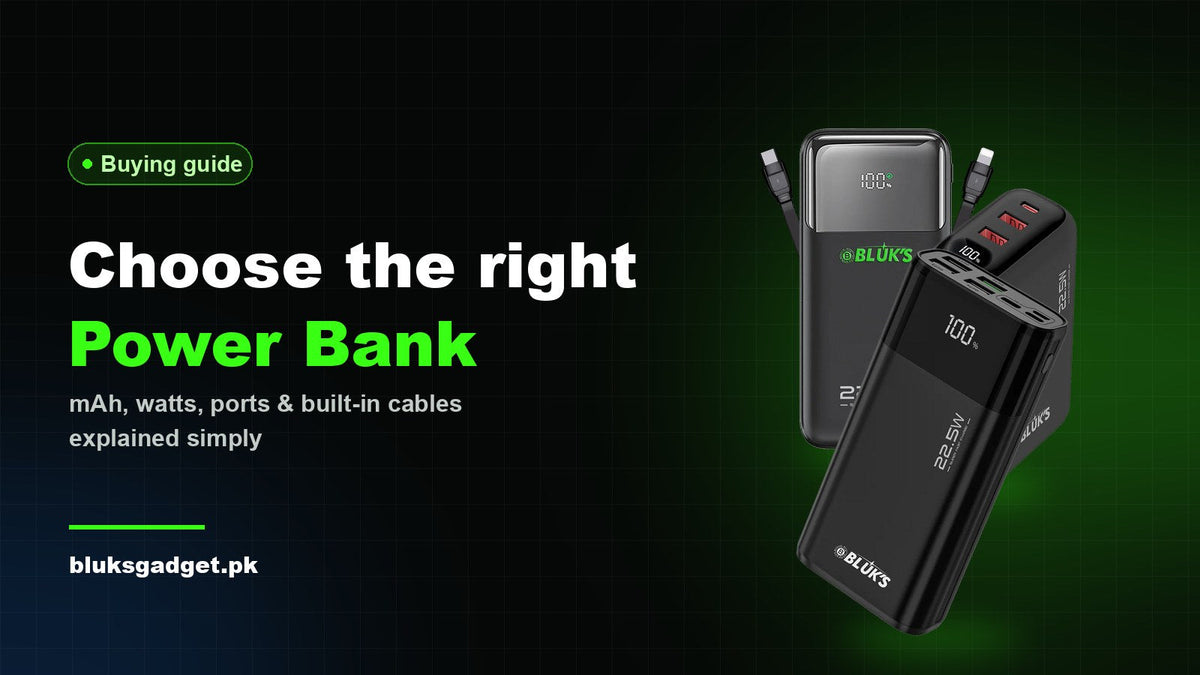
A power bank looks simple — until you're standing in front of ten of them that all say "20000mAh". This guide explains what the numbers actually mean, so you can pick the right power bank for your phone, your day and your budget.
1. Capacity (mAh): how many charges will you really get?
Capacity is printed in mAh (milliamp-hours). The bigger the number, the more energy it stores. But you never get 100% of it into your phone — some energy is lost as heat and in voltage conversion. As a practical rule, expect roughly 60–70% of the printed capacity to reach your device.
- 10,000mAh — around 1.5–2 charges for most phones. Light and pocket-friendly, good for daily commuting.
- 20,000mAh — around 3 charges for most smartphones. The sweet spot for travel, long workdays and load-shedding backup.
- 30,000mAh — for multi-day trips, charging a phone and a tablet, or keeping a whole family's devices alive.
2. Charging speed (W): 18W, 20W or 22.5W?
Speed is measured in watts. A higher number means a faster top-up — if your phone supports it.
- PD (Power Delivery) over USB-C is what iPhones and most modern Android phones use for fast charging. 20W PD is enough to fast-charge an iPhone.
- QC 3.0 (Quick Charge) is common on Android phones over USB-A. 18W–22.5W gives a noticeably quicker charge than a basic 10W port.
Look for a power bank that supports both PD and QC if your family uses a mix of iPhone and Android.
3. Ports and built-in cables
Count the devices you carry. If you charge a phone, earbuds and a smartwatch, you want at least two outputs. Built-in Type-C and Lightning cables are a big convenience — nothing to forget at home, and fewer wires in your bag.
4. Display, safety and build
- A digital display shows the exact battery percentage, so you know when to recharge the power bank itself.
- Look for protection against overcharging, overheating and short circuits.
- Aluminium and PC+ABS bodies handle daily bag life well.
5. Travelling by air?
Power banks must go in cabin baggage, never checked luggage. Most airlines allow power banks under 100Wh (a 20,000mAh power bank is about 74Wh), but rules differ between airlines — always check with yours before you fly.
Which Bluk's power bank fits you?
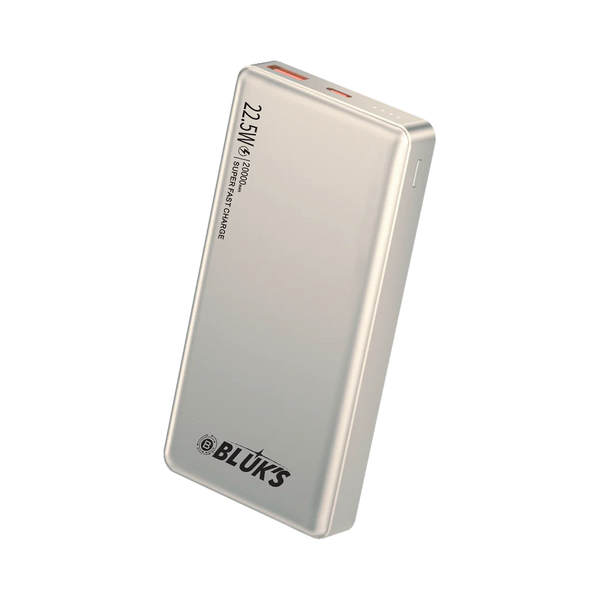
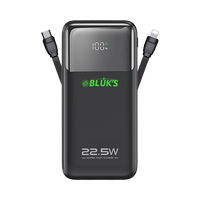
- Built-in cables + fast charging: BX-314 XON-PROMAX and BX-313 XON-PRO — 20,000mAh, 22.5W with PD and QC 3.0, built-in Type-C and Lightning cables and a digital display.
- Charge up to five devices: BX-305 SwiftCharge — 20,000mAh with USB-A, Type-C, Micro USB and Lightning, 22.5W QC and 20W PD.
- Everything in one compact unit: BX-304 — 20,000mAh, 22.5W USB-A and 20W USB-C output, built-in USB-C and Lightning cables, LED display.
- Tough metal body: BX-400 — 20,000mAh, 22.5W, dual USB-A, Micro USB and USB-C, aluminium alloy body.
- Maximum endurance: BX-401 — 30,000mAh with built-in Lightning and Type-C cables and a digital display.
- Slim everyday carry: BX-312 XON-AIR — 20,000mAh in a slim body with dual USB output.
- Android quick charge on two ports: BX-303 — 20,000mAh with 18W Quick Charge 3.0 and dual USB-A.
See the full range with live prices in our Power Bank collection. Every Bluk's power bank comes with the official brand warranty, and Cash on Delivery is available across Pakistan.
Quick checklist
- Daily use → 10,000mAh. Travel or backup → 20,000mAh. Multi-day → 30,000mAh.
- iPhone → make sure it has 20W PD. Android → QC 3.0 / 22.5W.
- Hate carrying cables → choose built-in cables.
- Always buy from an official seller so your warranty is valid.


